Rethinking Build vs. Buy in the AI Era
Artificial Intelligence
Business Software
Iterative Development

Author
Caleb Woods

AI lets almost anyone build an app in a couple of hours, so whether you can build it is no longer a useful filter. The better question is what's worth building. Buy the infrastructure, build the hub around the work that's unique to your business, and know when a tool has become a software asset you'll need to maintain.
SHARE POST
For years I have said that all software starts as a spreadsheet. What changed is that AI lets someone build an app almost as easily as a spreadsheet, and sometimes more easily. More and more, I'm seeing that the first prototype of a custom software application is a vibe-coded app.
That changes the build vs. buy decision. Build used to mean custom software, with a team and a budget behind it, and buy meant something off the shelf. Now anyone with an idea can have something running in a couple of hours, and whether you can build it stops being a useful filter.
What should you build when AI can build almost anything?
The question I ask most often is simple. Do lots of other businesses have this same problem, even in different industries?
If they do, someone has already built a product for it, with years of investment behind it that a custom version won't match. Accounting is an easy example. Often the best answer is to just use QuickBooks. The same goes for most project management, ERP, and document management tools.
If the problem is tied to the unique way your business works, the answer changes, because that is usually where your competitive advantage lives. We often see this in quoting and estimating, as that process takes engineering understanding, product expertise, or judgment. The work is pulling out the rules behind that judgment and encoding them into software the whole team can use. We call this Expertise Amplification.
You don't build everything. You buy the infrastructure, often SaaS tools, and your custom software becomes the hub that connects it to the parts of your process that are unique to your business. You build the hub around the work where it creates the most value.
What's the best way to solve a business problem with AI?
Most people start by building software, because that's what they've always known. In my experience, it is often the wrong first step. There are more than two paths, and building a full system is usually the last one you need.
Start with a workspace
A lot of workflows need a workspace before they need an app. A workspace is one place the team owns, connected to the systems already running the business, where AI works across real data. Each person runs their own copy on their own machine, and nothing in it is exposed to the internet, so there is far less to maintain. Our free AI Workspace guide walks through how to set one up.
Buy an existing tool
Buy something first to see which features you really need. When I wanted to run faster, I paid for a coaching app. I did eventually build my own, and I knew exactly what to build because I had used theirs first.
Build a prototype
A vibe-coded prototype is a fast way to get clarity. Working software shows you what you actually need, even when the code isn't perfect, and you learn a lot by building it.
Build a sustainable software system
Things get harder when the prototype has to leave your machine. A tool built in a weekend demos well, but then it needs logins, hosting, patches, and someone to fix it when the data changes shape. Building software has always meant signing up to maintain it, and AI hasn't changed that. When it is tied to your competitive advantage you will keep building on it for years. AI can write code from a specification. It can't pull that specification out of your business or design an architecture that holds up as the system grows.
How do you know when a tool has become a software asset?
Every tool sits somewhere on two scales: how much depends on it, and how long you will keep building on it.
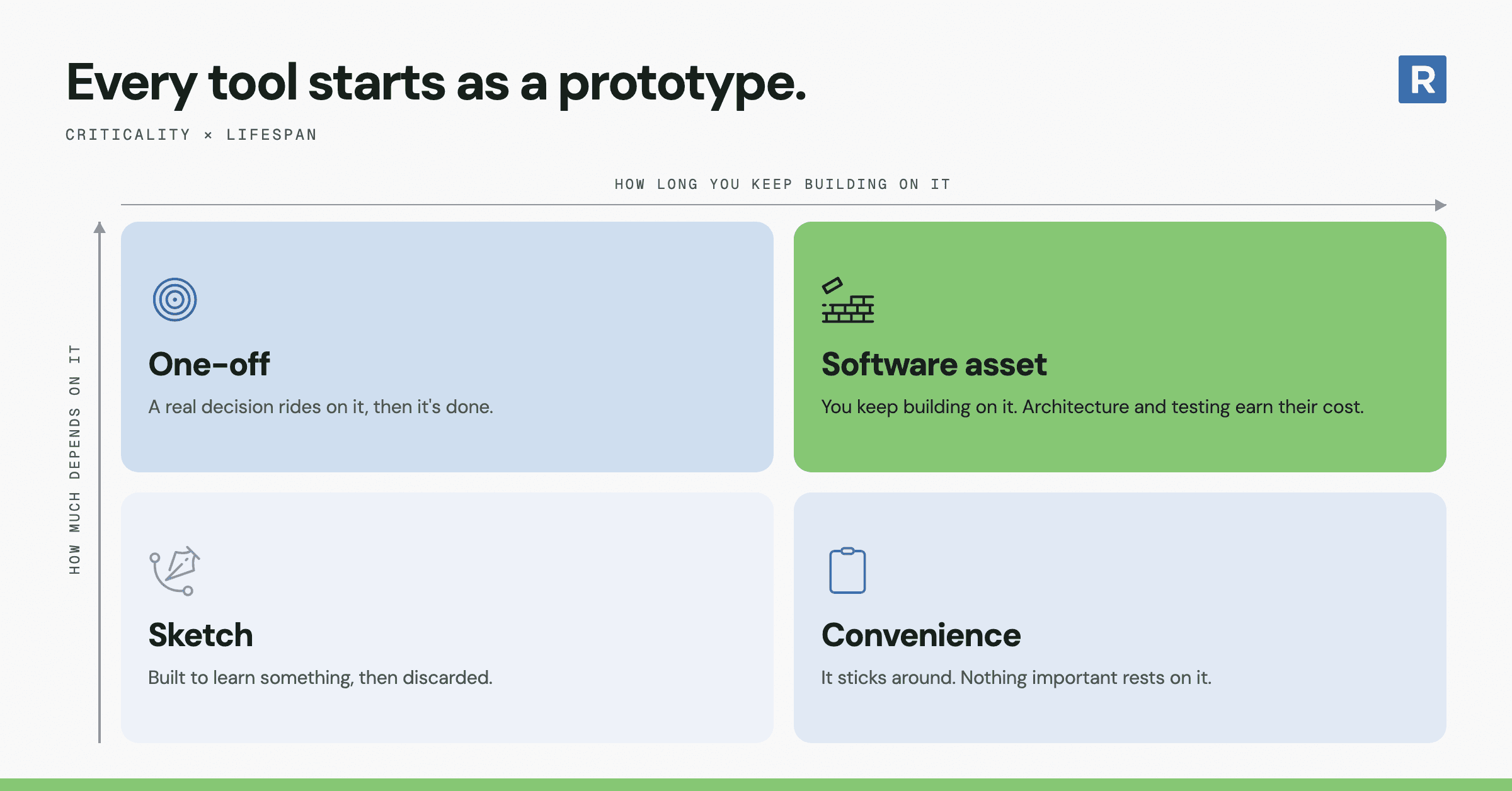
Three of the four boxes are tools, not assets. A sketch is low-stakes, built to learn and then thrown away. A one-off is high-stakes: a real decision rides on it, and then it's done. A convenience is low-stakes and long-lived, which is where a lot of experiments start, with nothing really riding on them. None of those need architecture or a test suite.
High-stakes, long-lived software is an asset. That is where architecture and testing earn their cost, and where maintenance is a commitment you have to plan for.
You don't usually set out to build a software asset. You get there by succeeding. It works, so more people use it, so you keep adding to it. The utility one person built becomes the thing three people depend on daily, then something your customers use as the face of your company. Nobody stops to say the stakes just changed.
I've watched this happen to our own tools, like Almanac, which started as a small internal tool for tracking billable hours. Today it connects the off-the-shelf tools we use and is the glue across RoleModel, especially in our AI workflows. Success gets you a system people depend on. Making it sustainable takes deliberate work, and while AI can help, it won't bring the judgment of people who have spent years building sustainable software systems.
How do you decide what to build and how to build it?
It starts with answering a few key questions.
What problem are we trying to solve?
Is this something unique to our business?
What is the smallest thing we could build?
Who will deploy it, keep it patched, and maintain it?
I've found the smallest thing you could build matters most. A small first version tells you whether the idea holds up before you've committed to maintaining it, and it keeps every later decision cheaper.
Where we start
Everything we do starts with a conversation about the options, whether we are building something for our own team or helping a partner decide. We start with the problem before the technology. AI has opened up new ways to solve business problems, and building software is only one of them.
If you have an interesting problem you are trying to solve, I'd love to chat and see what advice we can offer. We'll come back with two things: what you could do on your own, and how we could work alongside you. Sometimes the best advice is to stick with something off the shelf, or to skip building and do something simple with the AI tools you already have.
If you'd rather start on your own, our free AI guides are a good place to begin.